Your CX team hears about customer problems every day. Your product team decides what gets built. When the two don't talk, problems sit in a dashboard while the roadmap moves on without them. Closing that gap is one of the fastest ways to make VoC pay off.
Why CX and Product Drift Apart
Different goals
CX teams are measured on satisfaction and retention. Product teams are measured on shipping and adoption. Both care about customers, but they look at them through different numbers. Neither view is wrong. The trouble starts when each team optimizes its own numbers and nobody owns the problems that fall between them.
Different language
CX reports talk about themes and sentiment. Product teams think in user stories and backlog items. A CX report that says “billing frustration is up 20%” doesn't tell a product manager what to build. Translate feedback into the format product already uses.
Same customers, different numbers
CX teams
- Measured on satisfaction and retention
- Talk about themes and sentiment
Product teams
- Measured on shipping and adoption
- Think in user stories and backlog items
Give Product Teams Direct Access to Customers
Product managers make better decisions when they hear customers directly. Atlassian's Claire Drummond described product marketing as “the voice of the customer” and said those teams “fight hard to get a seat at the table.” CX teams often face the same fight.
Share the raw words
Summaries help, but real quotes stick. Include a few unedited comments with every theme. Invite product managers to listen to support calls or read a sample of tickets each month. Some teams run a monthly session where product managers spend an hour reading feedback with the CX team. It's a small time cost that builds shared understanding quickly.
Free review snapshot
See what your customers are saying, before you talk to us.
No commitment. We use your details only to send your snapshot and follow up. Privacy policy
Measure Success Together
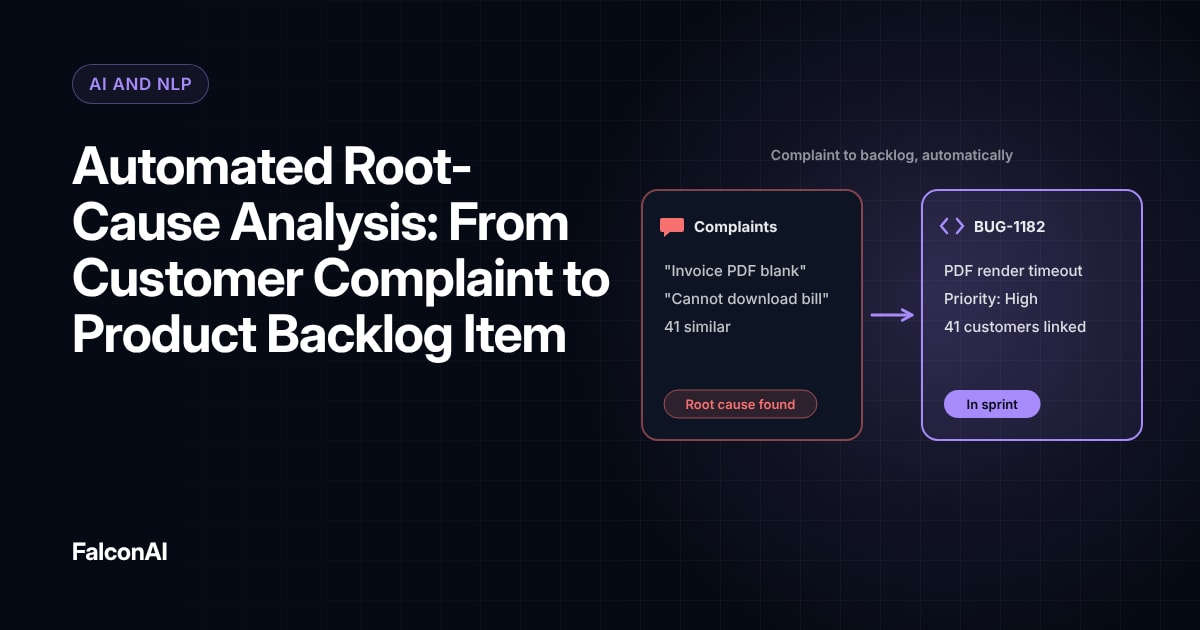
Pick shared measures, such as how many top themes reached the backlog and how quickly fixes shipped. Track whether complaints on those themes dropped afterward. Our guide to automated root-cause analysis shows how to move themes into the backlog automatically.
Forrester's 2025 research on feedback management found that many teams miss chances to respond to neutral and positive feedback. Product teams can help here. When a feature earns praise, they can learn what worked and repeat it.
Celebrate the wins
When a fix ships and complaints drop, tell both teams. Shared wins build trust faster than any process. Post a short note in a shared channel each time a customer-reported issue gets fixed, with a quote from the customer who raised it. Our post on building the right roadmap with VoC covers the product side. You can share themes across teams in CSAT analysis, or book a demo.
Frequently asked questions
Why don't CX and product teams work well together?
They have different goals and speak different languages, so feedback often doesn't reach the backlog in a usable form.
How often should CX and product meet?
A short review every two weeks works for most teams.
What should CX bring to product?
The top feedback themes, the number of customers affected and a few real quotes.
Should product managers talk to customers directly?
Yes. Hearing customers firsthand helps them make better decisions.
How do you measure CX and product alignment?
Track how many top themes reach the backlog and whether complaints drop after fixes ship.
Who owns telling customers about fixes?
CX usually owns the message, with product confirming what changed.