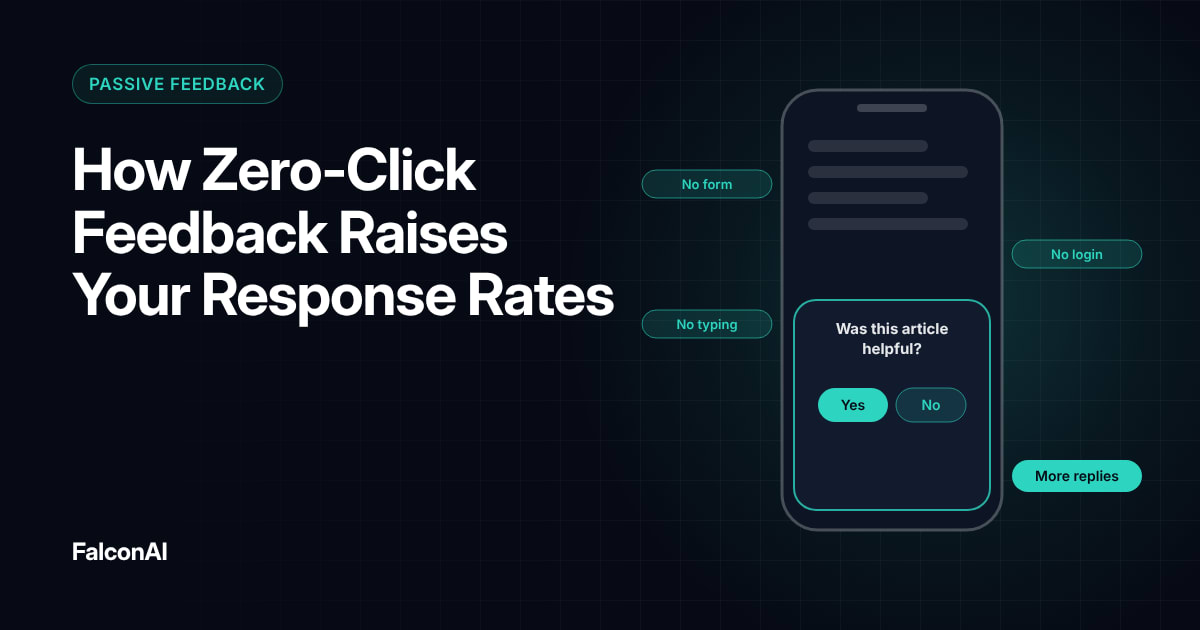
Somewhere in your company, there's a 20-question customer survey. Someone built it years ago, and every team added a question or two. Now hardly anyone finishes it. Micro-surveys fix this by asking one or two questions at a time.
Why Long Surveys Fail
Every question you add costs you respondents. One benchmark study found that surveys with one to three questions had an average completion rate of 83%. That fell to 65% for four to eight questions and 42% for 15 or more.
Time matters too. Survey platform data shows abandonment climbs for surveys that take more than seven or eight minutes, with completion rates dropping 5% to 20%. Gartner's 2024 research found that response rates fall when a survey takes too much time or effort.
Speeding hurts your data
The people who stay don't always give you good answers. The same platform data shows respondents spend less time on each question as a survey gets longer. Late answers get rushed, so the back half of your survey holds your weakest data.
Average completion rate by survey length
Source: One benchmark study. Figures as cited in this article
What a Micro-Survey Looks Like
A micro-survey has one to three questions and takes under a minute. It usually appears right after a specific moment, like a closed ticket or a finished onboarding step.
A simple template
Most micro-surveys need just two parts:
- A rating, such as CSAT or a 0 to 10 NPS scale
- An optional open question: “What's the main reason for your score?”
That's it. Track the rating over time and read the comments for the reasons behind it.
How to Cut a Long Survey Down
List every question in your current survey, along with the decision it informs and who owns that decision. Delete any question without an owner.
Then split what's left by moment. Questions about support go into a post-ticket micro-survey. Questions about onboarding go into a post-setup one. Our guide to event-driven feedback shows how to trigger each one.
Use data you already have
Don't ask for company size or plan type. Your CRM already knows. Pull those fields in through integrations and keep your survey for questions only the customer can answer.
How to cut a long survey down
- List every questionWith the decision it informs and its owner
- Delete the orphansAny question without an owner
- Split by momentPost-ticket, post-setup
- Use data you havePull plan and company size from your CRM
Free review snapshot
See what your customers are saying, before you talk to us.
No commitment. We use your details only to send your snapshot and follow up. Privacy policy
Getting Depth Without Length
Short surveys can still give you rich insight. Ask small questions more often. In one 2025 study, 58% of people in a frequent small survey group were still responding by the fourth round, compared with 50% in a monthly long survey group.
Customers notice the difference. “Survey fatigue is real,” Qualtrics president Brad Anderson told Fortune. Short, relevant asks respect that.
Let AI read the comments
The optional comment is where depth lives. AI theme detection groups those comments so you don't need ten extra multiple-choice questions to find patterns. Analyze them in CSAT analysis. To shrink the ask even further, read about zero-click feedback, or book a demo.
Frequently asked questions
What is a micro-survey?
A micro-survey is a short survey of one to three questions, usually shown right after a specific customer action.
How long should a customer survey be?
Aim for under a minute. Completion rates fall sharply as you add questions, and abandonment rises past seven or eight minutes.
What is a good survey completion rate?
Short surveys of one to three questions average around 83% completion in one benchmark study.
How do you shorten a long survey?
Delete questions nobody acts on, then split the rest into event-based micro-surveys.
Do micro-surveys give enough data?
Yes, when you send them often and analyze the open comments with AI.
Should every survey include an open-ended question?
Include one optional open question. It explains the score without adding much effort.