Modern VoC systems collect far more than survey scores. They also pull in support chats and call recordings. That data can improve customer experience. It can also damage trust if customers feel watched. Many customers now think twice before they share.
Trust Drives Feedback
Cisco's 2024 Consumer Privacy Survey of more than 2,600 people across 12 countries found that 75% won't buy from companies they don't trust with their data. Harvey Jang, Cisco's Chief Privacy Officer, said, “Building and maintaining trust is a business imperative.”
Customers are wary of unexpected uses
Qualtrics' 2025 Consumer Trends report found that only 27% of consumers are comfortable with companies using unsolicited data for personalization. Feedback collected for one purpose shouldn't quietly move into another. Trust also shapes the quality of feedback. Customers who worry about how their words will be used tend to hold back, and guarded answers tell you less.
- 75%won't buy from companies they don't trust with their dataSource: Cisco 2024 Consumer Privacy Survey
- 27%are comfortable with unsolicited data used for personalizationSource: Qualtrics 2025 Consumer Trends
Figures as cited in this article
Principles to Build On
- Ask only for data you'll use.
- Explain clearly how you'll use feedback.
- Give customers an easy way to opt out.
- Remove personal details before broad analysis.
- Set retention limits and stick to them.
These rules work best when they're written down and reviewed each year.
Consent is ongoing
A customer who agreed to a survey didn't agree to have their call transcripts mined forever. Review consent whenever you add a new data source or a new use. Make opting out as easy as opting in. A buried unsubscribe link erodes the trust you're trying to build.
Principles to build on
- Ask only for data you'll use
- Explain how you'll use feedback
- Make opting out easy
- Remove personal details before broad analysis
- Set retention limits and stick to them
AI Raises the Stakes
AI can read every comment and recording you collect. That power needs guardrails. Cisco found that 78% of consumers say it's increasingly important for organizations to use AI responsibly. The same survey found regular use of generative AI nearly doubled in a year, from about 12% to 23% of consumers. As customers get more familiar with AI, they pay closer attention to how companies use it. Be clear when AI analyzes feedback, and keep people involved in decisions that affect individual customers.
Watch for bias in models
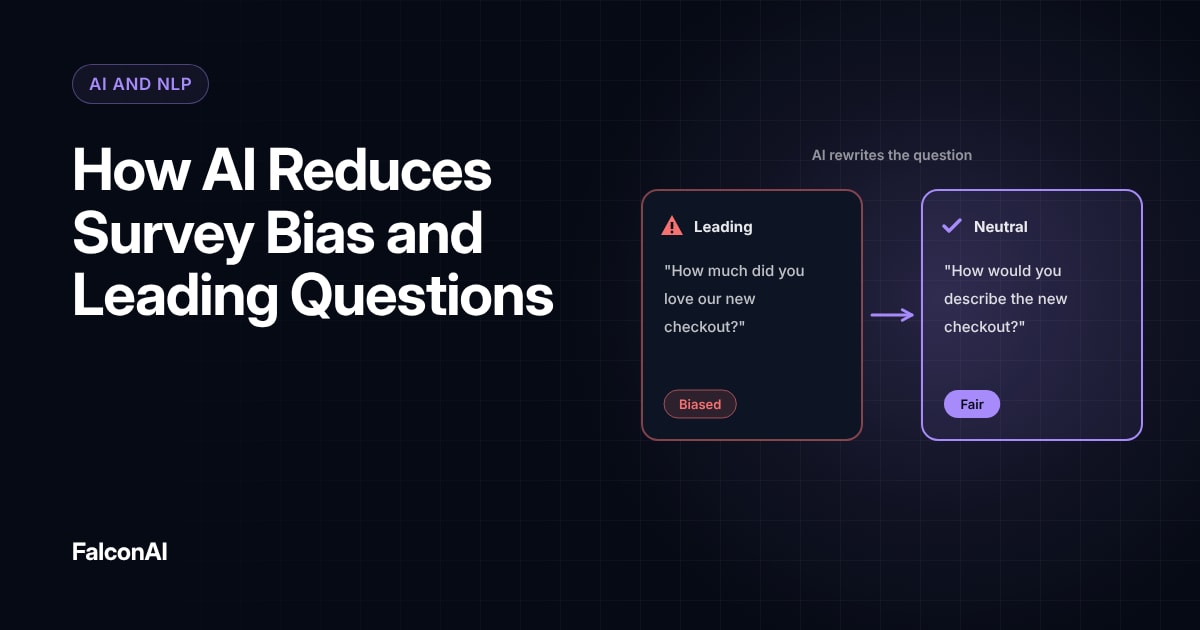
Models trained on skewed data can misread certain groups. Check whether comments from non-native speakers get tagged differently from the rest. Test outputs across segments before you act on them. Our post on AI and survey bias covers what to check.
Regular use of generative AI
Source: Cisco 2024 Consumer Privacy Survey. Figures as cited in this article
Free review snapshot
See what your customers are saying, before you talk to us.
No commitment. We use your details only to send your snapshot and follow up. Privacy policy
Make Ethics Practical
Write a short policy your CX and data teams can follow, and assign an owner who reviews new data sources before they go live. Share a plain-language version with customers so they know what to expect. Train frontline teams on the policy too. They're often the people customers ask about how feedback gets used.
Be transparent about results
When customers see that feedback leads to real fixes, they're more willing to share again. Our guide to closed-loop feedback explains how. Our post on feedback deduplication covers removing personal details during cleanup, and our guide to accessible feedback forms shows how to include every customer. You can analyze feedback securely in CSAT analysis, or book a demo.
Frequently asked questions
Why does data ethics matter for VoC programs?
Customers share honest feedback only when they trust how you'll use it.
What data should a VoC program collect?
Only the data you have a clear plan to use.
Do customers need to consent to feedback analysis?
Yes. Explain how you'll use their feedback and review consent when you add new uses.
How should personal details be handled?
Remove or mask them before feedback is shared widely or analyzed at scale.
Is it ethical to use AI on customer feedback?
Yes, as long as you disclose it clearly and test models for bias.
How long should you keep feedback data?
Set a retention limit based on your needs and local rules, then stick to it.