Your CFO doesn't care that NPS went up four points. They care whether revenue went up or costs went down because of something your team did. If you can't show that link, your VoC program looks like a cost center at the next budget review.
Why VoC ROI Is Hard to Prove
Most CX teams believe their work pays off. Few can show it. A 2026 survey of 600 US CX and support leaders found that only 21% had proven CX's direct impact on retention. Only 19% were measured on CX's impact on customer lifetime value.
The data lives in different places
The same survey found that 23% of teams named customer data trapped in disconnected systems as a top barrier. Jeremy Suriel, CTO of the customer service company behind that survey, put it bluntly: “Proving ROI is a data architecture problem before it's a reporting problem.” Before you build a single chart, make sure feedback and revenue data sit in the same place.
- 21%had proven CX's direct impact on retentionSource: 2026 survey of 600 US CX leaders
- 19%were measured on CX's impact on lifetime valueSource: 2026 survey of 600 US CX leaders
- 23%named data trapped in disconnected systemsSource: 2026 survey of 600 US CX leaders
Figures as cited in this article
Start With the Money Your CFO Already Tracks
Your CFO already watches churn and renewal rates closely. Tie your VoC metrics to the numbers finance trusts. Here's where to look:
- Retention of customers whose complaints you fixed, compared with similar customers you didn't reach.
- Support cost per contact before and after a root cause fix.
- Renewal rates for accounts with high scores and low scores.
- Expansion revenue from accounts that gave positive feedback.
Compare groups of customers
Averages hide the effect you want to show. Compare groups over the same period. Detractors who got a follow-up call should renew at a higher rate than detractors who didn't. That gap, multiplied by contract value, is a number your CFO will read.
Numbers finance already trusts
- Retention of customers whose complaints you fixed
- Support cost per contact, before and after
- Renewal rates for high and low scores
- Expansion revenue from positive accounts
Build the ROI Case Step by Step
Count the revenue you kept
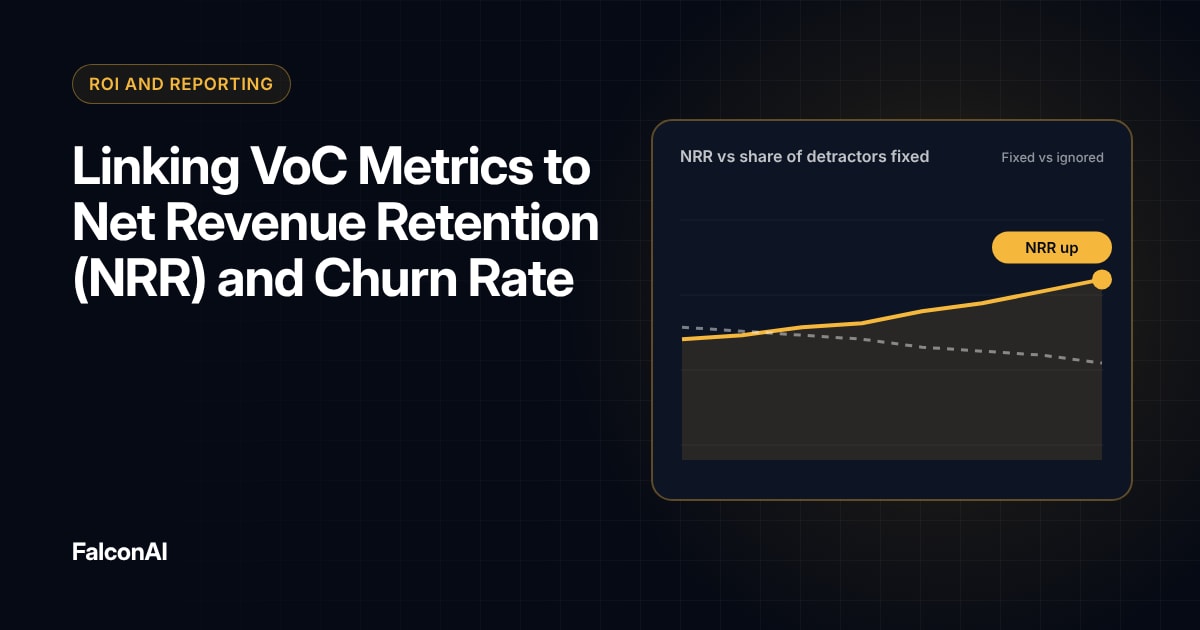
Take the accounts your team saved after a negative score. Multiply the number of saves by average contract value. Our guide to linking VoC metrics to net revenue retention shows how to track this each quarter.
Count the costs you avoided
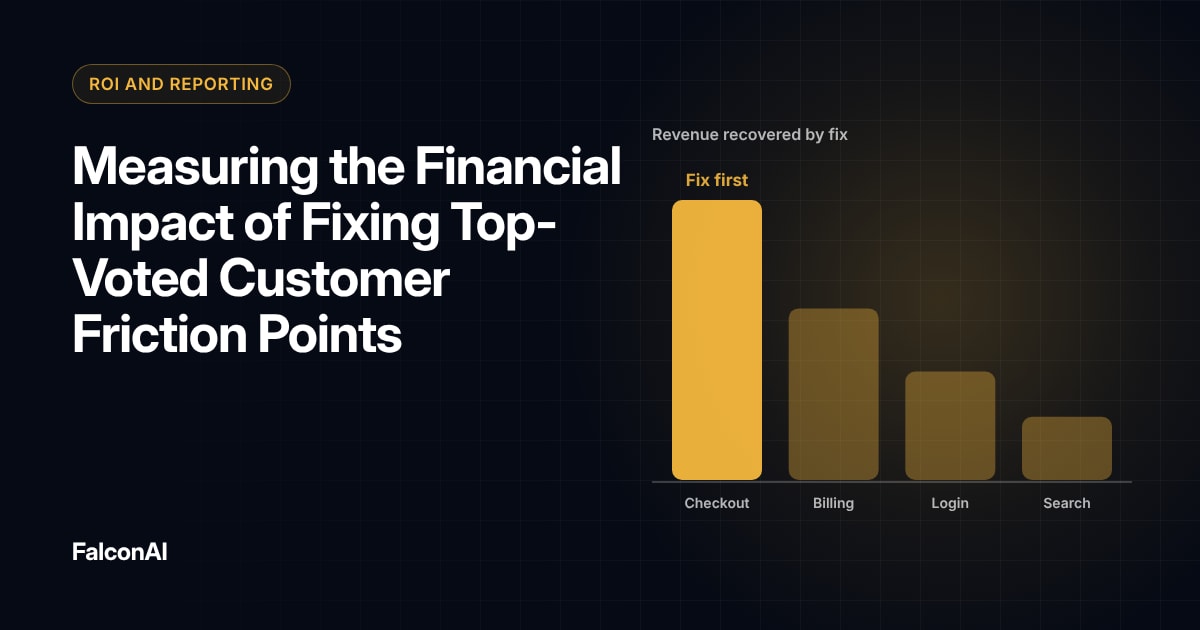
When you fix a root cause, tickets on that issue drop. Multiply the drop by your cost per ticket. Our post on measuring the impact of fixing friction points walks through the math with a worked example.
Building the ROI case
- Count the revenue you keptSaves multiplied by average contract value
- Count the costs you avoidedTicket drop multiplied by cost per ticket
- Present it like financeBaseline, change, then dollar value
Free review snapshot
See what your customers are saying, before you talk to us.
No commitment. We use your details only to send your snapshot and follow up. Privacy policy
Speak the CFO's Language
CX Network's Global State of CX 2025 found that nearly 40% of CX professionals named demonstrating ROI as their top obstacle to getting buy-in. Present results the way finance already does. Start with the baseline and the change, then give the dollar value with your assumptions written down.
Forrester principal analyst Pete Jacques has said that “even a minor improvement to a brand's customer experience quality can reduce churn and increase share of wallet.” Your job is to show your CFO where that happened in your own numbers.
Keep the report short
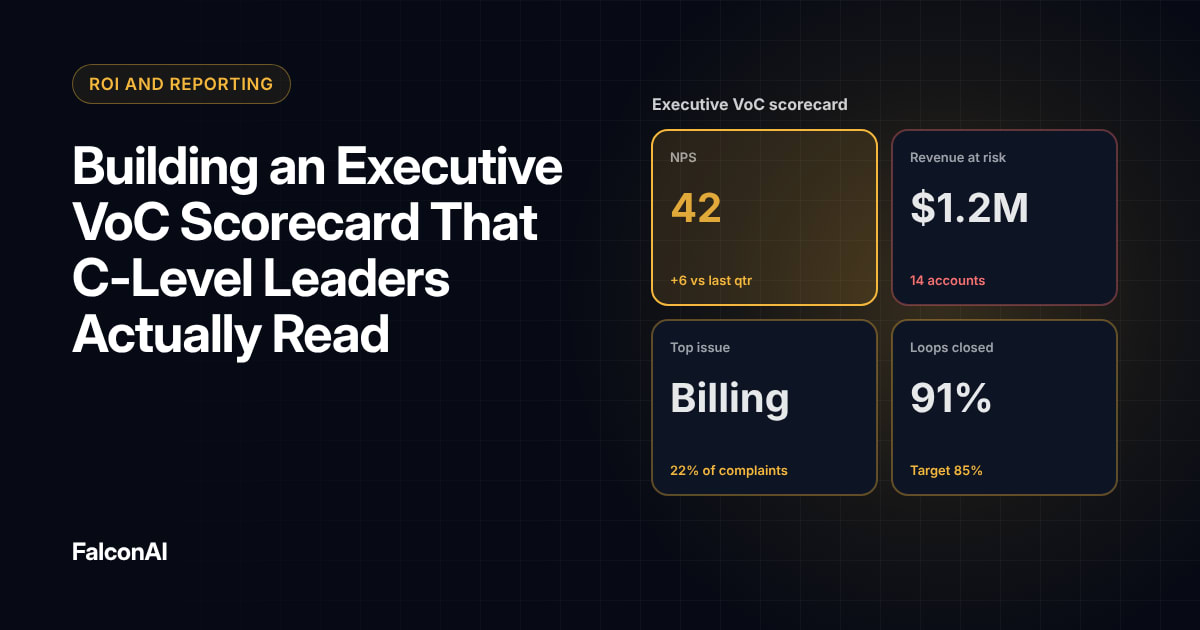
One page is enough. Lead with dollars saved and kept, then show how you calculated them. Ask finance to check your inputs before the meeting, since a number they've already reviewed is hard to argue with. Our guide to building an executive VoC scorecard covers the layout. You can track retention by score in NPS analysis, or book a demo.
Frequently asked questions
How do you calculate VoC ROI?
Add the revenue you kept and the costs you avoided, then divide by what the program costs to run.
What metrics matter most to a CFO?
Retention and renewal rates come first. Expansion revenue and cost to serve follow close behind.
How long does it take to prove VoC ROI?
Plan for at least two renewal cycles so you have enough data to compare groups of customers.
Can you prove ROI without a data team?
Yes. A simple comparison of customer groups in a spreadsheet is often enough for a first business case.
Should you report NPS to the CFO?
Report it alongside the revenue it links to. A score on its own rarely holds a CFO's attention.
What if the ROI looks small?
Show it anyway, with your assumptions. A small, honest number builds more trust than a big guess.