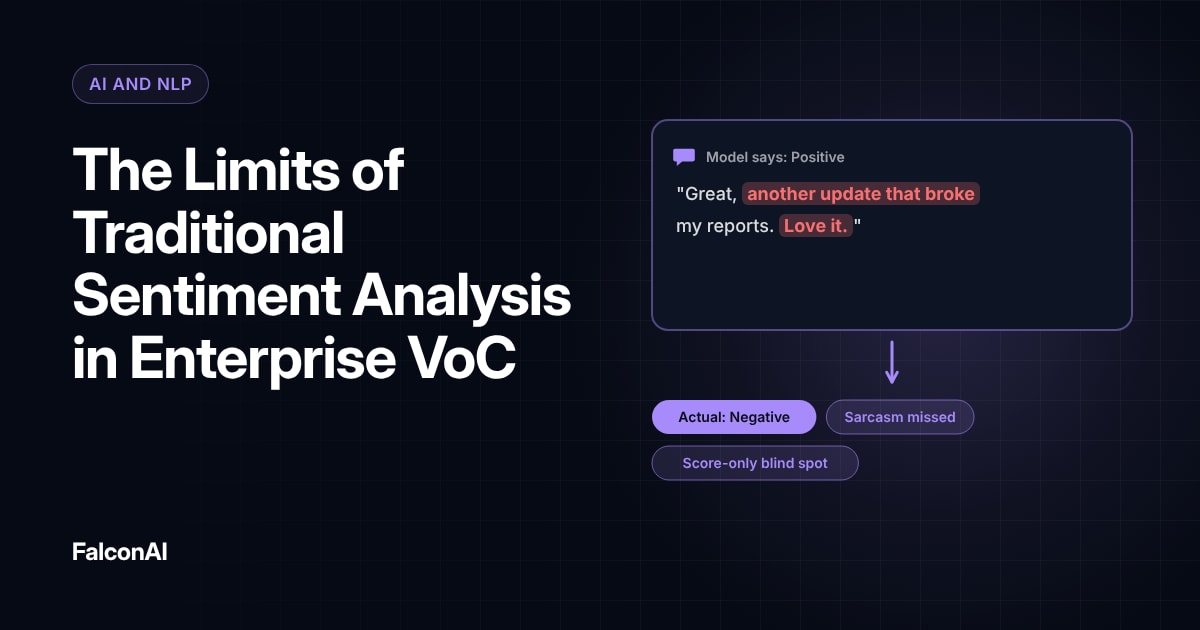
“Great, another update that broke everything.” A basic sentiment tool sees “great” and scores that comment as positive. Your product team never hears about the broken update. Sarcasm and context are where feedback analysis most often goes wrong.
Great, another update that broke everything.
From this article
Why Sarcasm Is Hard for Machines
Sarcasm says the opposite of what it means. People pick it up from tone of voice and the situation around it. Written text strips most of that away. Sarcasm also clusters around frustration. Customers rarely use it when they're happy, so a missed sarcastic comment is usually a missed complaint.
What the research shows
A 2024 study in the Journal of Student Research compared several large language models on sarcasm detection. The models varied widely, and one was clearly weaker on sarcastic sentences than plain ones. The authors concluded that AI still needs work on this kind of language.
Context Matters as Much as Sarcasm
Same words, different meaning
“It's fast” is praise for a checkout flow and a complaint about a billing cycle. “I'm done” might mean a customer finished setup, or that they're about to cancel. The meaning depends on the product and the moment in the customer's journey.
Emoji and punctuation add another layer. A thumbs-up after a complaint can mean “fine, whatever.” A row of exclamation marks can signal excitement or anger. Models that read the whole message, including these marks, get closer to the real meaning.
Industry context
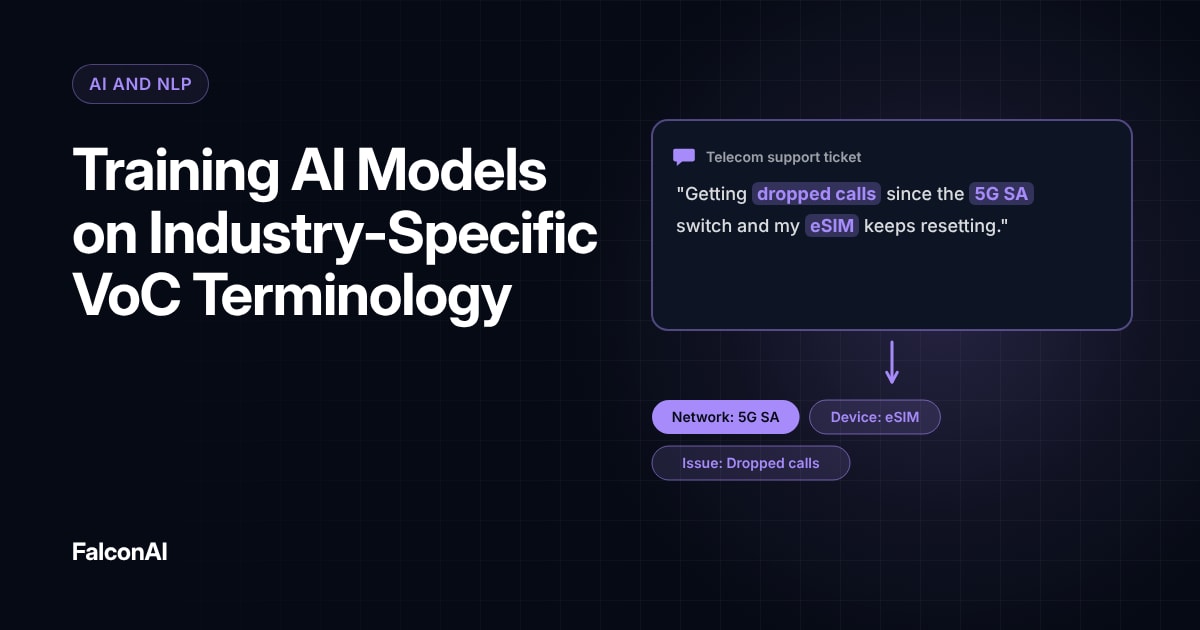
Words carry different weight across industries. In healthcare, a “positive” result can be bad news. In telecom, a “drop” usually means a lost call. Our post on industry-specific VoC terminology covers how to teach models your vocabulary.
How to Catch What Customers Mean
Modern models read whole sentences and the text around them. They do much better than word lists, though they still make mistakes. Here's how to reduce them:
- Give the model context, such as the product area and survey question.
- Compare the comment with the score. A 2 out of 10 with “great job” is almost always sarcasm.
- Flag low-confidence labels for a person to check.
- Feed corrected labels back into the model.
Read the score and text together
The score is often your best sarcasm detector. When the number and the words disagree, trust the number and send the comment for review. Our guide to the limits of traditional sentiment analysis explains why one label isn't enough.
Reducing sarcasm and context errors
- Give the model contextProduct area and survey question
- Compare comment with scoreWhen they disagree, trust the number
- Flag low-confidence labelsFor a person to check
- Feed corrections backCorrected labels go into the model
Free review snapshot
See what your customers are saying, before you talk to us.
No commitment. We use your details only to send your snapshot and follow up. Privacy policy
Why It's Worth the Effort
Mislabeled comments hide real problems. Zendesk's 2025 CX Trends Report found that 63% of consumers would switch to a competitor after one bad experience. A sarcastic complaint scored as praise is one of those bad experiences, and nobody followed up on it.
Bruce Temkin, who led Qualtrics XM Institute, urged companies to “intensify your focus on understanding and responding to your customers' feelings.” Sarcasm is a feeling too, and often a strong one.
Measure your error rate
Each month, pull the comments where score and sentiment disagree and check them. Track how often the model gets them right. If accuracy drops after a product change, check whether customers have started using new phrases. You can review mismatched comments in NPS analysis, or book a demo to see it on your data.
Frequently asked questions
Can AI detect sarcasm in customer feedback?
Modern models catch a lot of it, especially with context, but they still miss some. Review a sample by hand.
Why does sentiment analysis miss sarcasm?
Older tools score individual words, so “great” reads as positive even when the customer means the opposite.
What's the easiest way to spot sarcasm?
Compare the comment with the score. A low score with positive words is a strong sign.
Does context improve accuracy?
Yes. Telling the model the product area and survey question helps it read meaning correctly.
How common is sarcasm in feedback?
It varies by industry and channel. Social posts and reviews tend to have more of it than survey comments.
Should you remove sarcastic comments from analysis?
No. They often carry strong feelings about real problems. Label them correctly and route them like any other complaint.